

Investing in the Intelligence Age: Scaling Aerospace Capacity Through Advanced Manufacturing
The global aerospace industry is accelerating again. Production rates are rising, order books stretch years ahead, and quality expectations continue to intensify. This renewed pressure is emerging at the same moment the world enters what KPMG calls the Intelligence Age. In its January 2026 Global Tech Report, based on insights from 2,500 technology leaders across 27 countries, KPMG notes that 79 percent of organisations now sit within the top three maturity stages across major technologies. Yet only 11 percent say they are fully scaled and continually evolving. Ambition is high — half expect to reach top maturity by the end of 2026 — but the execution gap remains wide.
The UK is well positioned to respond. It combines world class research capability with a strong advanced manufacturing base, creating fertile ground for robotics, automation, and digitalisation. But the February 2026 Global Robotics Clusters Study from the Manufacturing Technology Centre highlights a familiar challenge: adoption still lags. The UK deploys 104 robots per 10,000 manufacturing workers, compared with a global average of 177. Increasing uptake — particularly among SMEs — and strengthening the bridge between research and industrial deployment could unlock significant productivity gains. Government analysis suggests that accelerating adoption across manufacturing and services could deliver substantial long term GDP growth.
KPMG’s report shows why progress is slow. Sixty nine percent of executives admit that in their push to move fast, they have created tradeoffs in areas such as security, scalability, and data standards. Sixtythree percent say the cost of fixing technical debt is holding back investment in new initiatives. Scaling advanced technology is difficult — and manufacturing faces the same constraints.
The economic implications are clear. UK manufacturing productivity sits 16 percent below the G7 average. Between 2000 and 2022, the UK’s share of global manufacturing value added fell from 3.1 percent to 1.9 percent. The MTC study argues that robotics and related technologies could contribute up to £223 billion in GDP uplift by 2035 if adoption accelerates.
For aerospace suppliers, these figures translate directly into operational and strategic risk.
A Practical Response to a Structural Challenge
At ASG Aerospace, the response is grounded in engineering discipline. If output must rise, it must rise without instability. That means higher utilisation of equipment, more predictable processes, and faster industrialisation of new work packages. Automation is central to that shift.
Simon Weston, CEO of ASG Aerospace, defines capacity in new terms:
“It is not just about adding machines. It is about increasing throughput per asset, per shift, and per engineer — without losing control.”
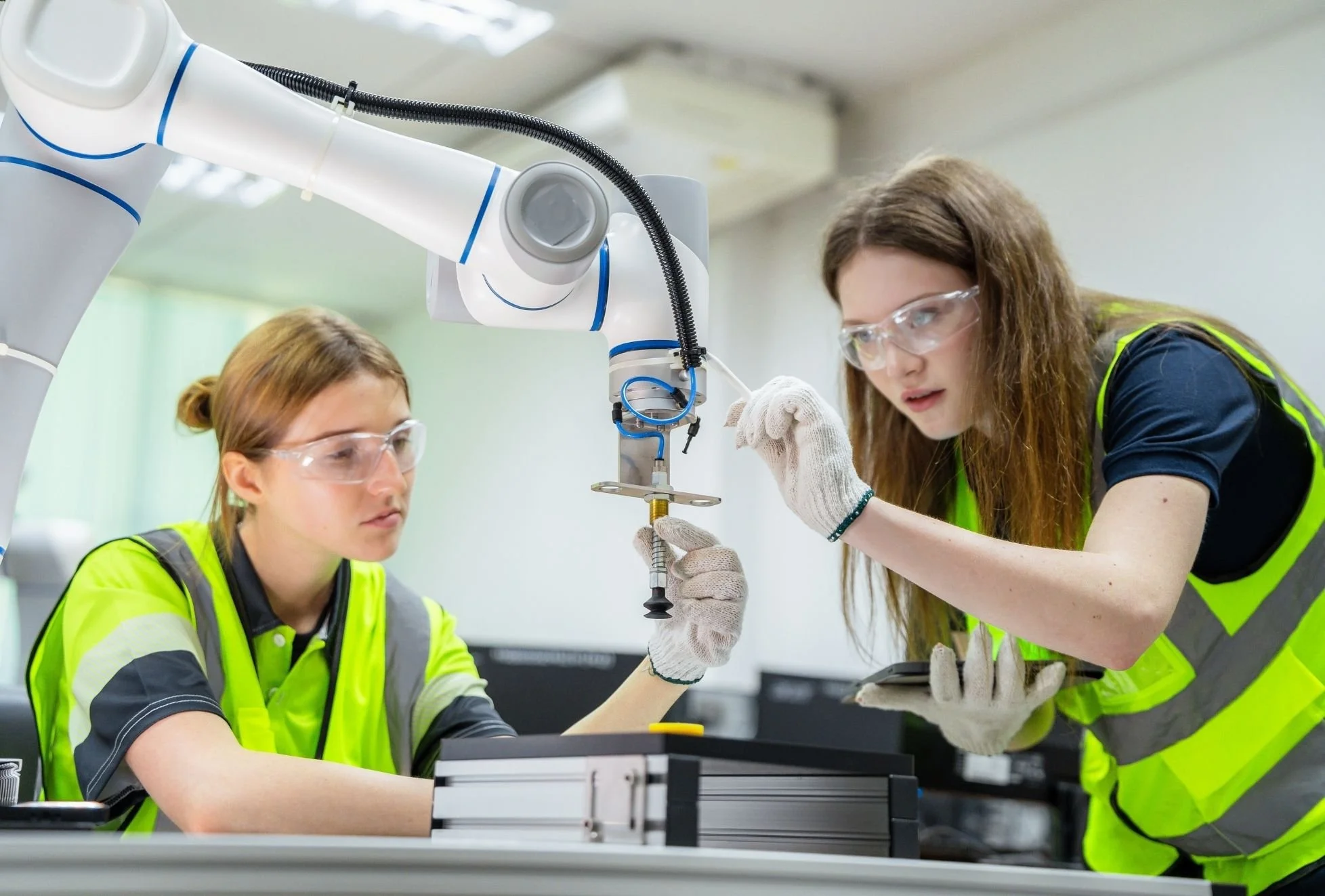
Across ASG Aerospace sites, automation is being embedded in layers. New multi-axis machining centres are commissioned with integrated pallet systems and monitoring capability to enable extended unattended running. Existing cells are being upgraded with robots and collaborative robots to stabilise cycle times, reduce manual handling variability, and support consistent quality.
At ASG Bremerhaven, operations manager Marcus Griep has long championed connected manufacturing.
“I worked in technical sales for automation for three years — consulting, planning, installation, and support for automation in machining. This was on turning and milling machines,” he explains. His message is straightforward: automation integrates seamlessly into conventional production when the engineering is done properly.
Digital Capability as a Second Pillar
KPMG reports that 78 percent of organisations aim to be scaling or fully scaled in advanced simulation and digital twins by 2026. The rationale is clear: better forecasting and scenario planning strengthen resilience. Yet 67 percent of executives say ineffective forecasting still hampers their ability to respond to shocks.
For ASG Aerospace, digital twins allow machining strategies, robotic movements, and production flows to be validated before physical rampup. This reduces commissioning time, cuts rework, and supports more stable rate increases — all essential in a highmix, highprecision environment.
Strengthening the Research–Industry Bridge
A key part of scaling capability in the Intelligence Age is building stronger links between research institutions and industrial operators. That connection was reinforced during Mandy Ridyard’s recent visit to KIT Karlsruhe, one of Europe’s leading centres for production engineering, robotics, and intelligent manufacturing systems.
The visit focused on three themes central to ASG Aerospace’s strategy:
Translating research into deployable industrial capability, particularly in automation and digital twins.
Understanding emerging robotics architectures that could accelerate stable, unattended machining.
Exploring collaborative pathways between UK and German innovation ecosystems to support faster industrialisation.
The visit underlined the importance of aligning academic research with realworld production challenges — ensuring that new technologies can be industrialised quickly, safely, and at scale.
Technology Works When People Do
KPMG’s data shows that while AI adoption is accelerating — with 68 percent expecting to reach the highest level of AI maturity by 2026 — most organisations anticipate only modest reductions in permanent roles. High performers tend to invest in people alongside technology.
ASG Aerospace follows the same philosophy. Automation changes roles, but it does not remove responsibility. Engineers shift toward process control, programming, optimisation, and systemlevel thinking. Upskilling runs in parallel with capital investment, ensuring people grow as the technology footprint expands.
Execution, Not Technology, Creates Advantage
Both KPMG and the MTC point to the same conclusion: technology alone does not create competitive advantage. Governance, integration, and disciplined execution do. High performers centralise decision making, reduce technical debt, and align execution tightly to strategy.
In aerospace — where regulatory pressure, delivery schedules, and quality requirements leave little margin for error — that discipline is nonnegotiable.
The coming rampup cycle will reward suppliers who can increase output without destabilising operations. Automation, robotics, and digital validation are no longer experiments; they are engineered capabilities.
For ASG Aerospace, scaling capacity in the Intelligence Age means building resilient, interconnected systems that can run hard, run predictably, and run safely. It is a structured, evidence led response to the demands of the next aerospace cycle — and to the realities of the Intelligence Age itself.