

Long-Bed Machining Built for Aerospace Scale and Complexity
As the aerospace sector looks towards the Farnborough International Airshow 2026 in July, attention will turn to production ramp-up, future platforms and supply chain resilience. Suppliers able to deliver large, complex components at scale are becoming critical to OEM performance.
For ASG TGM in Preston, that requirement is centred on one thing: capability.
The business has built its reputation by taking on parts that are difficult to manufacture and making them production-ready. From early work replacing chemically etched components with precision-machined alternatives—reducing waste, cost and lead times—to solving complex forming and fit challenges on titanium aero-structures, its focus has remained consistent: make challenging parts repeatable.
“ASG TGM has always been at its best when customers bring us something difficult,” says Sarah Stephens. “Our strength is understanding the part, the process and the risk, then creating a stable manufacturing route.”
That approach is underpinned by targeted investment, particularly in long-bed machining—a capability of growing importance as aircraft structures increase in size and complexity.
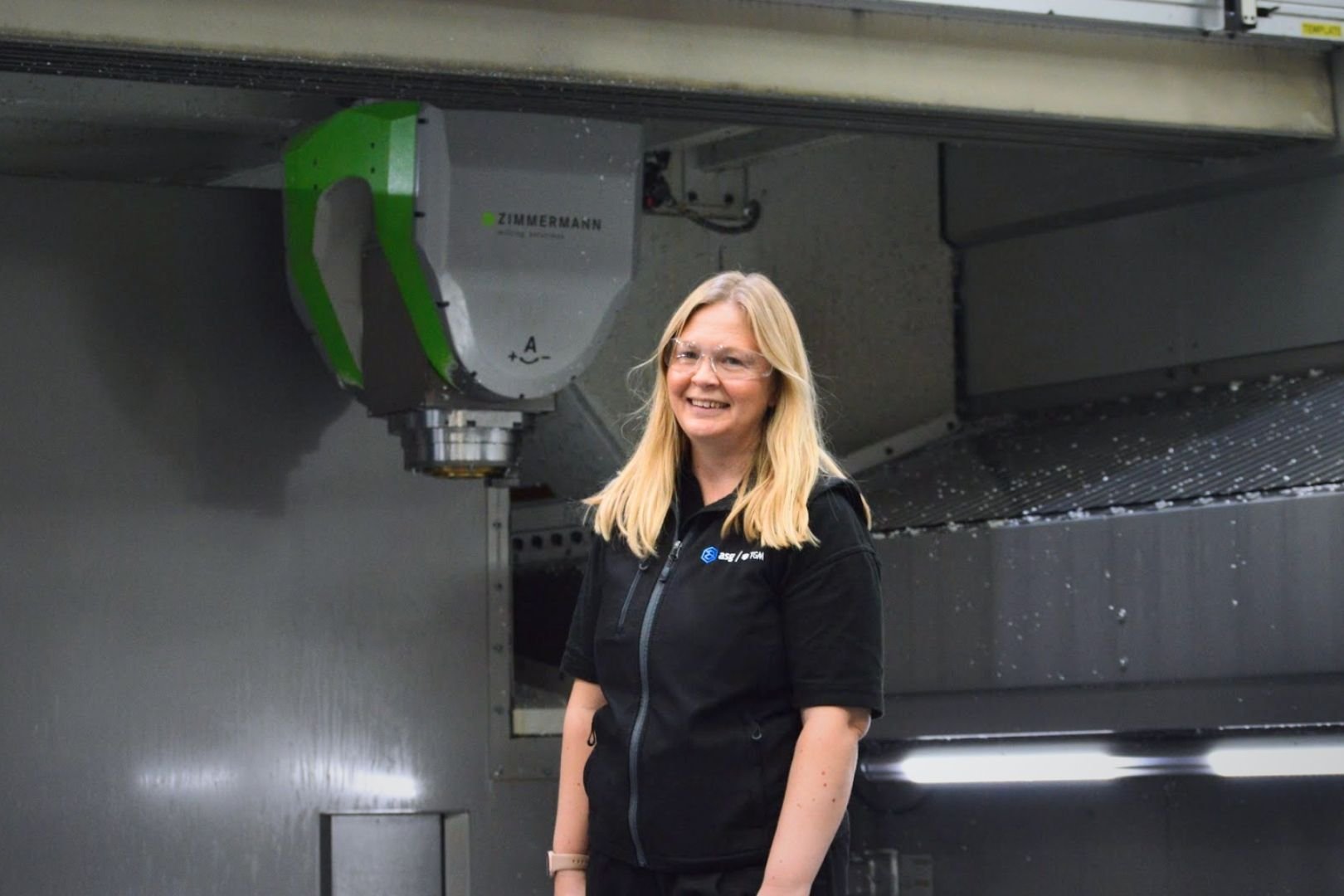
At the centre of this strategy is a large-bed Zimmermann 5-axis machining centre, installed as part of a £1.3 million investment. The machine enables the manufacture of large, high-accuracy aerospace components in a single set-up—reducing risk, improving repeatability and opening access to work that many suppliers cannot accommodate.
“The Zimmermann changed the scale of what we could offer,” Stephens says. “It allows us to compete for complex structural work where accuracy over long machining lengths is critical.”
That initial investment became the foundation for a broader expansion in long bed machining capability. ASG TGM subsequently committed a further £1.75 million in 2024-5 into additional large-format machining capacity through the installation of three Mazak VTC-800/30SDR 5-axis machining centres at its expanded Preston facility.
Configured for complex aerospace structural work, the machines feature full CNC 5-axis travel, Mazatrol Matrix controls and 30-position tool changers, supporting the machining of large titanium and aluminium aero-structures with high levels of repeatability and process stability. Each machine provides a 3 metre by 1 metre working envelope, aligned to growing demand for larger structural aerospace components and extended machining cycles.
The investment was part of a wider expansion strategy following the acquisition of an additional 11,000 square feet adjacent to ASG TGM’s existing Preston operation. This created additional capacity for high-complexity aerospace programmes and strengthened the site’s role within the wider ASG Aerospace manufacturing network.
Rather than simply adding machine capacity, the Mazak investment created overlapping production capability around the original Zimmermann platform. With mirrored 5-axis machining cells operating across the Preston site, ASG TGM strengthened its ability to support programme ramp-up, manage production continuity and reduce supply chain risk for aerospace customers.
“The working envelope of these machines is a perfect match for the parts we’re now taking on,” Dan Hall, Director of ASG TGM says. “At 3 metres long and with full 5-axis control, they allow us to achieve geometries and tolerances that simply weren’t possible before.”
Stephens says the strategy is centred on building resilience into aerospace manufacturing operations as demand for large structural components continues to increase.
“With multiple VTC platforms operating across the facility, we’re creating flexibility and continuous workflow capability,” she says. “Those are critical advantages when customers are looking for long-term programme stability.”
Long-bed machining remains a high-barrier capability within the UK supply chain. It requires not just machine capacity, but advanced programming, robust fixturing, process control and inspection discipline across extended cycle times.
ASG TGM has continued to build around that core strength. Expansion of its Preston facility and further investment in advanced 5-axis machining has created a more flexible and resilient production environment capable of supporting increasingly complex aerospace work packages, including large structural ribs and spars for single-aisle aircraft programmes.
The strategy aligns with wider thinking across ASG Aerospace: building overlapping capability to support programme continuity, manage ramp-up pressure and reduce supply chain risk across multiple manufacturing sites.
“The strength of ASG lies in our ability to share capability, capacity and knowledge across the group,” Stephens says. “The investment here in Preston complements the wider aerospace strategy and gives customers greater confidence in long-term delivery performance.”
With the Farnborough International Airshow only 70 days away, ASG Aerospace will be demonstrating its long-bed machining capability to the wider aerospace community, highlighting its resilience through strategic investment